

A unique experience in Haute Maurienne Vanoise
La Haute Maurienne Vanoise is an easily accessible area in the heart of the Alps, offering a wide range of sporting activities in winter and summer: climbing, skiing, biathlon, paragliding and dog sledding. It's the perfect place for unforgettable experiences.
Nevertheless, the beauty of the region is best revealed when discovering its villages, customs, wildlife and people, as well as its six tourist resorts: Valfréjus, La Norma, Aussois, Val Cenis, Bessans and Bonneval sur Arc.
And to help you discover Val Cenis, it's now possible to take a walk with alpacas. To meet the two camelids, we take the the Vieux Moulin gondola lift. Anne is waiting for us with Aster and Solcito when we arrive at an altitude of over 2,100 meters.
Anne was a professional firefighter. In winter, she works as a ski instructor in Val Cenis. The rest of the year, she works as a sophrologist. Since this summer, she's been offering a new way of bringing wellbeing and tranquillity to tourists and locals alike, through her alpacas.
Alpacas, from the Andes to the Alps
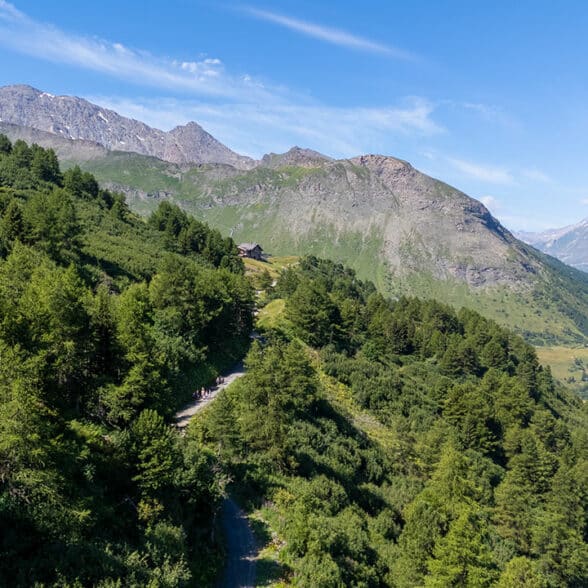
The mountain environment of the Haute Maurienne Vanoise allows holidaymakers to enjoy large, unspoilt natural areas, such as the famous Vanoise National Park. Many of the wild animals naturally found in the Alps can be observed here: ibex, marmots, bearded vulturevariable ptarmigan, chamois...
Alpacas, on the other hand, come from the Andes and are therefore perfectly adapted to the climate of Haute Maurienne Vanoise. Indeed, these camelids generally live in western Bolivia, northern Chile and southern Peru, in areas that sometimes exceed 4,000 meters in altitude.
These animals, close cousins of the llama (but smaller), are very alert and observant. Their eyesight, hearing and sense of smell enable them to spot anything going on in their surroundings.
Alpacas feed mainly on grass, but as Anne points out, "unlike goats and sheep, they don't pull up roots when they eat. So they're excellent mowers!"
They bring pleasure and joy to the people who walk with them.
Aster and Solcito
While alpacas and llamas are mainly used for breeding, or for work in South America, in Val Cenis "Aster and Solcito are intended for well-being. They bring pleasure and joy to the people who walk with them," explains Anne.
These camelids, both three years old, were born on French farms. They are both huacayas a breed of alpaca found mainly in Latin America.
Anne sheared them shortly before summer, to ensure their comfort during the hot summer months. She feeds them hay every day and observes them regularly to check their health. "They eat and drink very little compared with cows or sheep," she explains. When they're not out and about in Val Cenis, they live in a large enclosure she built for them near her house.
As part of this unusual wellness activity, Anne's two alpacas reach the summit of Vieux Moulin every Thursday by gondola. It's a short trip that doesn't faze them: after all, they've been training all winter for this journey.
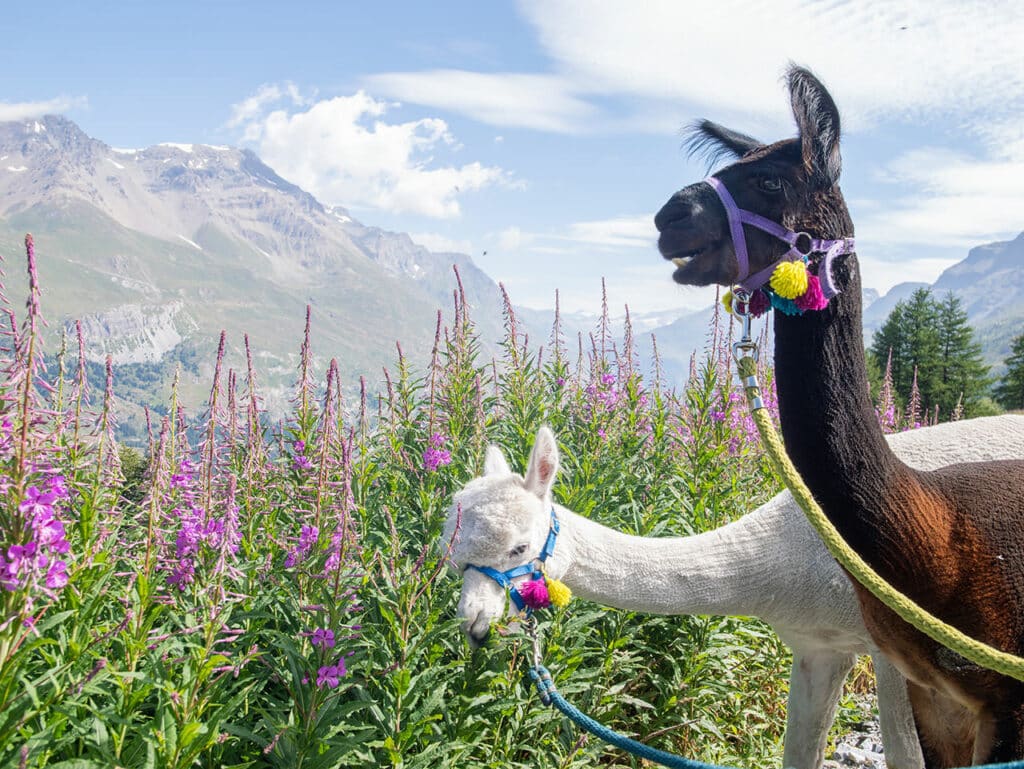
Selfie with alpacas and Vanoise glaciers in the background
A walk in the footsteps of alpacas
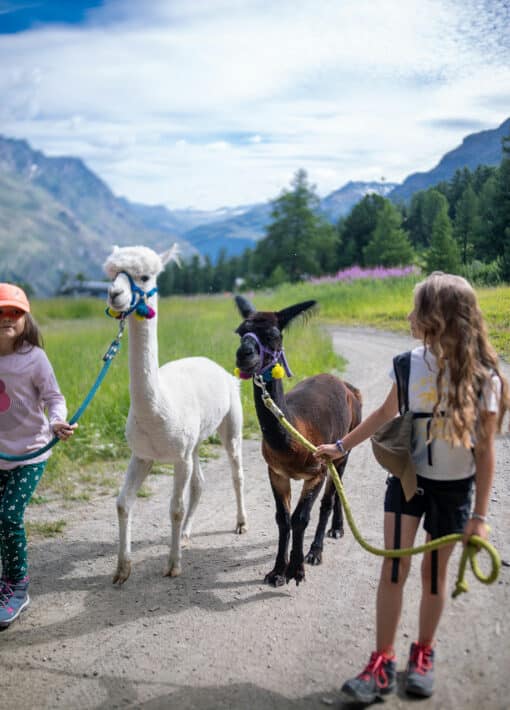
For this outing with the alpacas, we were a group of just ten people, accompanied by Anne and her son Gabin. Enthusiasm was alive and well. Young and old alike, everyone was eager to meet Aster and Solcito.
Alpacas are "eco-responsible" animals: they are efficient and selective grazers, consuming only the parts of plants they need, leaving the rest untouched.
After introductions and a few important instructions, it's off for the ride. I take Aster's lead rope and, immediately, he starts to follow me. I walk quietly, guiding the alpaca towards the route we need to take for our walk.
Calm and docile, the two alpacas stop only to eat the twigs of grass and willow found along the way: "alpacas don't eat much: around 2 kg of food a day", Anne informs us.
These stops also allow us to see the beauty of the Haute Maurienne Vanoise landscape: its mountains, valleys and greenery.
Animals with soft, delicate wool
An experience of well-being and tranquillity
Children and adults alike take turns petting and walking Aster and Solcito. Anne explains that alpacas are not afraid of humans. Sometimes, like all animals, they can be wary: " Alpacas are not afraid of humans. However, if something frightens them, they can run and jump up to 1.20 m in length."
After a good hour's walk, we reached a spot from which we could see in the distance the Vanoise glaciers. We took the opportunity to stop for a moment and take some souvenir photos with the two alpacas. The kind of photo that will be the stuff of dreams on the networks: altiplano ambience!
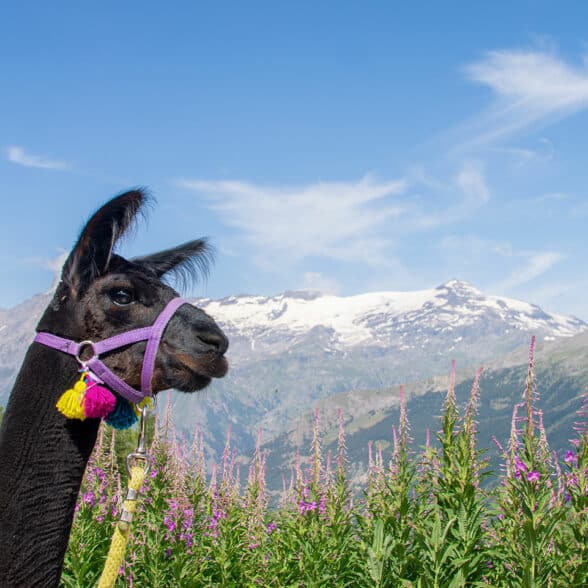
At this point, a rather surprising detail catches my eye: Aster, the white alpaca, always walks behind Solcito, the big brown alpaca. Anne explains that this is actually Solcito's way of putting himself forward, of being the leader and looking after his fellow alpaca, since a group of alpacas always needs a dominant one.
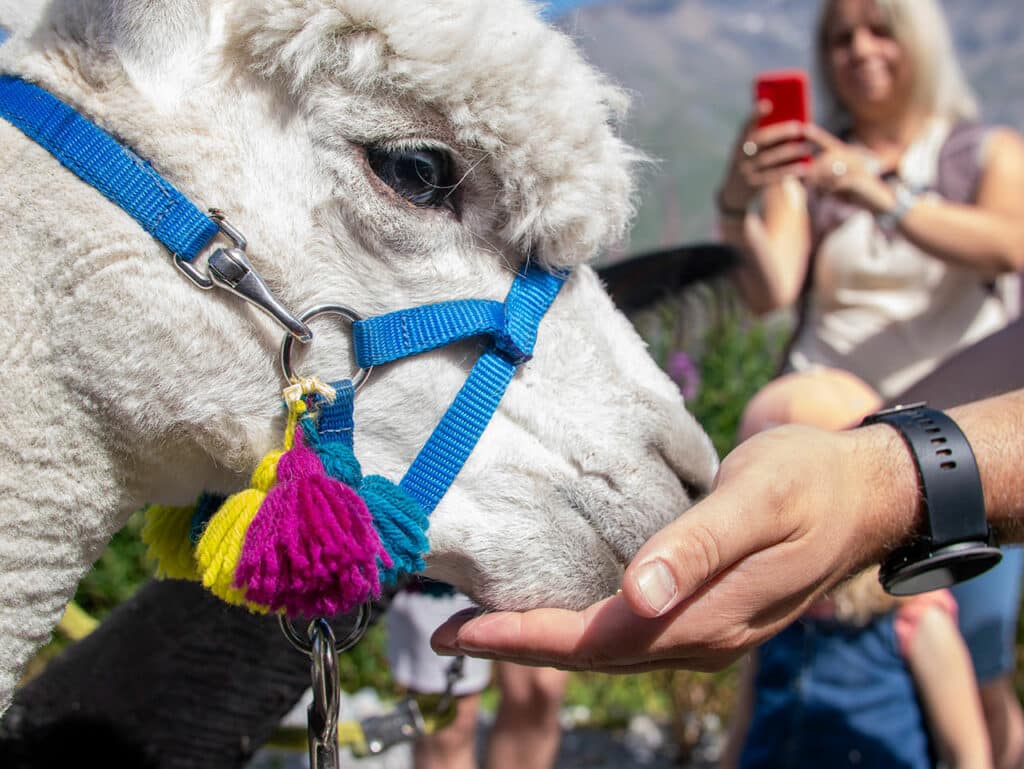
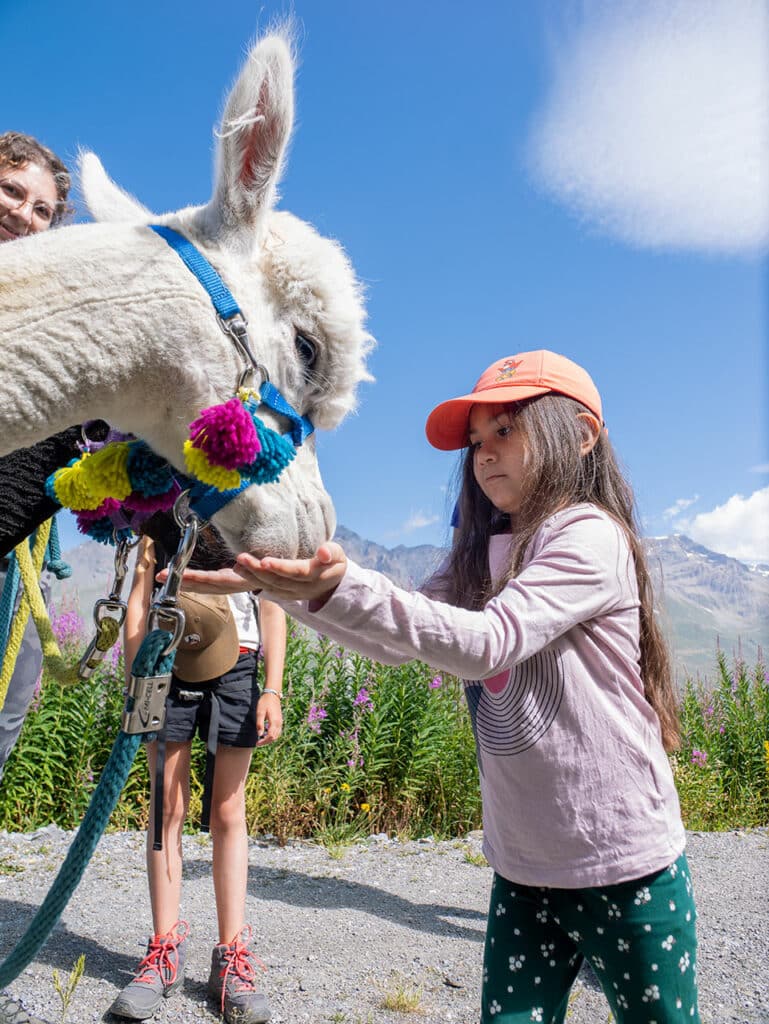
To reward the two camelids for their walk and good behavior, Anne takes some seeds out of her saddlebag so we can feed them. I give it a try: I'm a little apprehensive when I open my hand and Aster approaches, but all I feel is a tickle on my palm as he savors his seeds.
After that, it's time to head back to base camp. Always slowly, and at the pace of the animals.
Back near the Vieux Moulin gondola, Anne takes out of her saddlebag some wool from the two alpacas she'd collected earlier in the summer. The fur is soft, delicate and silky. She explains that, for the time being, this wool is only being preserved, for no particular use, but will eventually be used to make garments such as bedding, hats, mittens and scarves.
Finally, we end our magnificent hour-long stroll with some lovely gifts from Anne: everyone gets little bits of wool shorn from the two alpacas, accompanied by a bonus diploma certifying our new knowledge of the two animals.
Why should we try it?
A walk with alpacas at Haute Maurienne Vanoise is much more than a simple stroll: it's an immersion in a unique and memorable experience that combines the beauty of the region's landscapes with the gentleness and uniqueness of the Andean camelids.
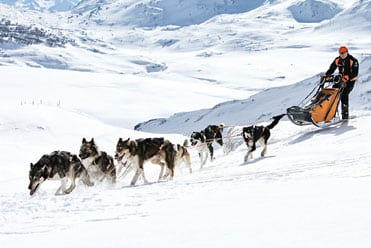
Husky Adventure - Dogsled sports school