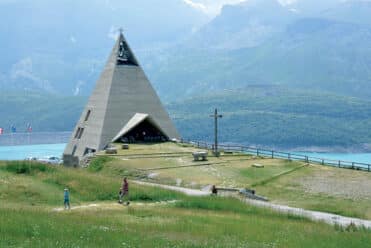


Why a pyramid on Mont Cenis?
It's a stunning piece of architecture. At an altitude of 2,100 metres, the Mont Cenis pyramid stands out against the military fortifications and the turquoise waters of the lake. A pyramid in the heart of the mountain pastures?
The idea may seem improbable, but this building, which houses a museum and chapel, is the distant heir to an architectural competition launched by... Napoleon Bonaparte.

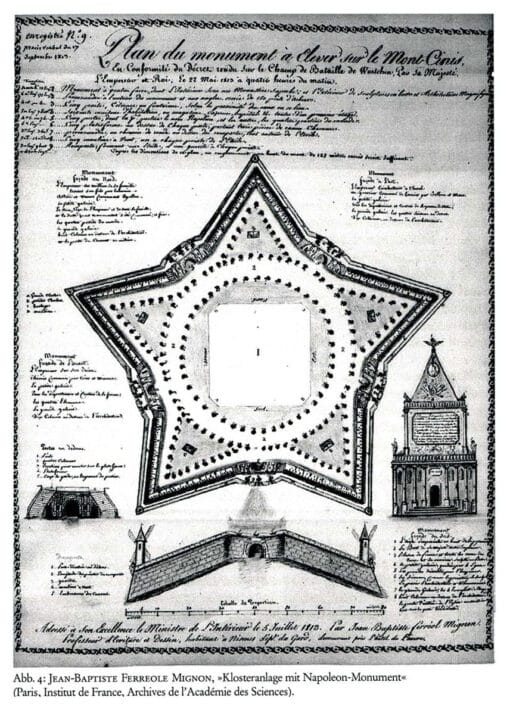
An international architectural competition
On May 13, 1813, following his victory over Russia and Prussia, Napoleon issued a decree ordering the construction of a monument at Mont-Cenis. A competition was launched, and architects from all over the empire were invited to submit designs. A budget of 25 million francs was earmarked for the project, an enormous sum for the time and a clear indication of the importance the Emperor attached to Mont Cenis, a strategic site ideally placed between France and Italy.
A strategic site for Napoleon
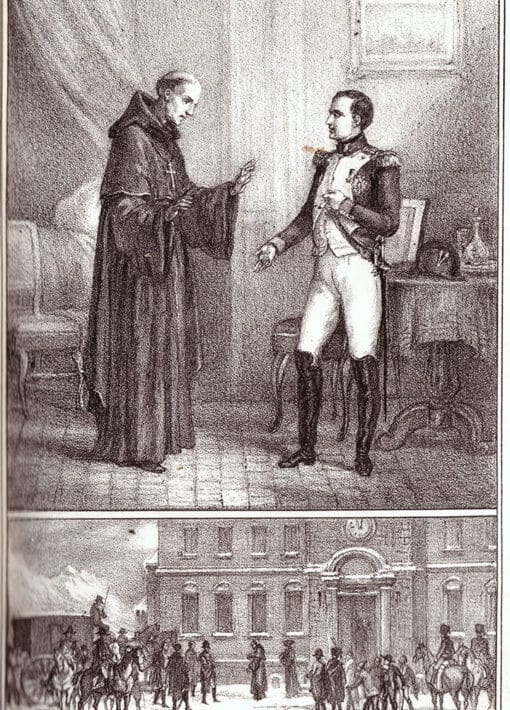
Napoleon passed through Mont Cenis several times. In 1805, for example, he found himself snowbound above Lanslebourg. He had to spend several days at the former Mont Cenis hospice, then run by Don Gabet, to regain his strength.
It was against this backdrop that he decided to considerably improve this strategic route for his troops. He had the present road from Val Cenis to Susa built and the hospice enlarged. The modest building was completely transformed and could accommodate up to 2,000 soldiers and 250 horses! Napoleon even had the ambition of building an entire town and settling 5,000 inhabitants on this high-altitude plateau.
Celebrating Franco-Italian friendship and...
...the Emperor's victories!So it's no coincidence that Napoleon was thinking of Mont-Cenis for a monument. A building that would not only celebrate his victories at Lützen and Wurschen, but above all illustrate the Franco-Italian alliance.
In June 1813, a commission of the Imperial Institute was created. It brought together architects, representatives of the Beaux-Arts, literary scholars and historians. This commission was tasked with listing the various projects received as part of an architectural competition.
Propaganda architecture
At a time when Europe is a vast battlefield, organizing such a competition for a monument at Mont-Cenis may seem incongruous. But the project was also conceived as a stimulus in Napoleon's very difficult political context: propaganda architecture in the service of the empire.
Despite extremely tight deadlines, the projects piled up. French, Italian and Dutch architects worked on Mont-Cenis, proposing monuments as varied as they were extravagant.
Napoleonic pyramids
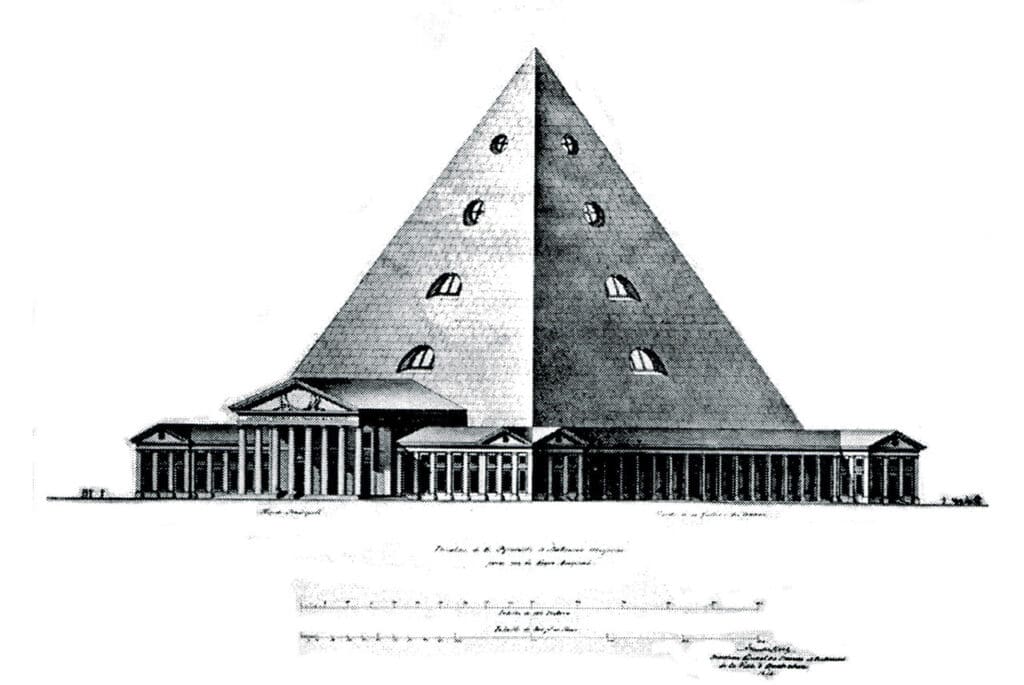
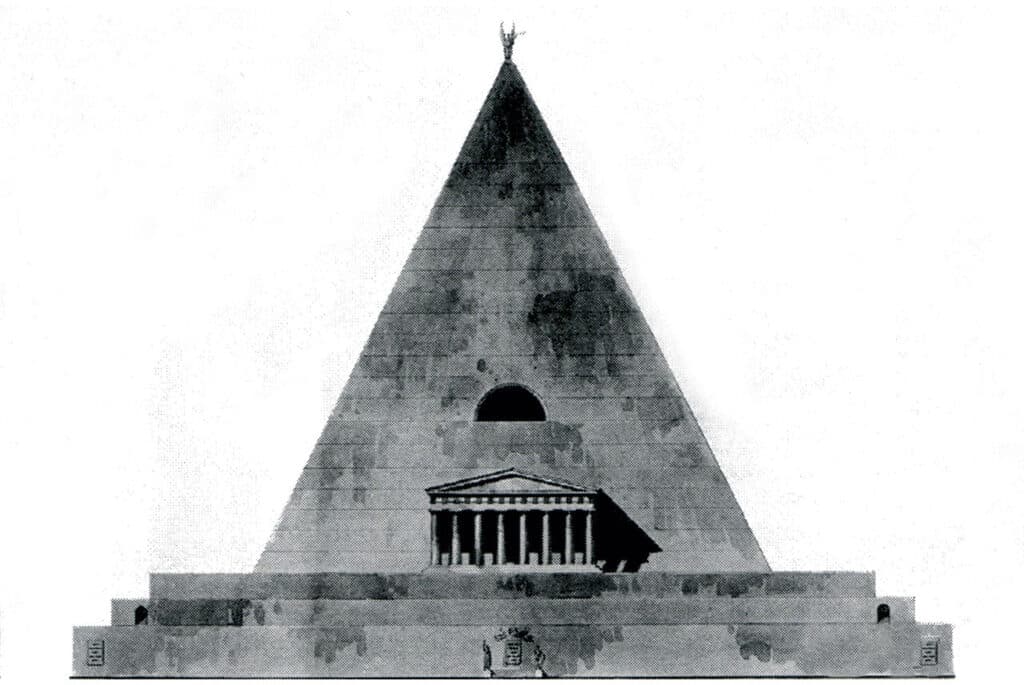
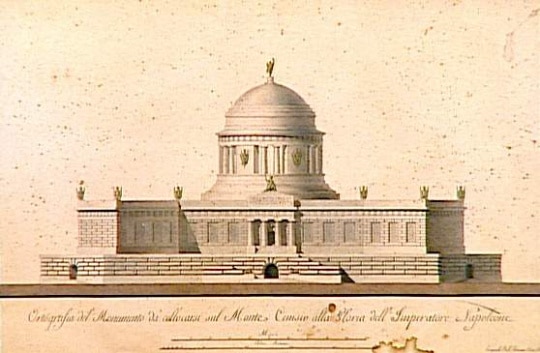
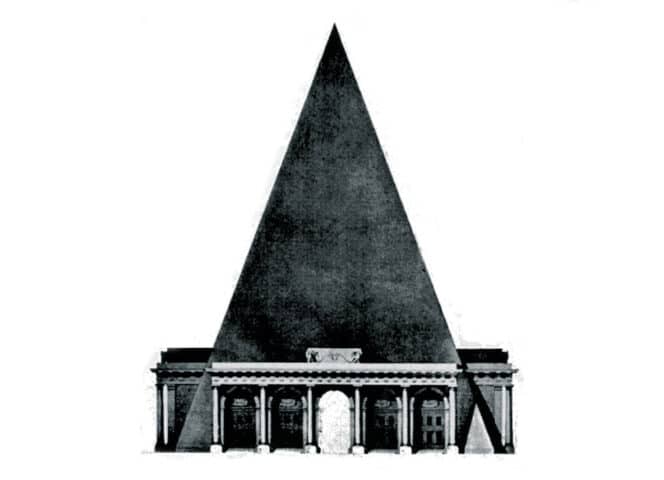
The Napoleonic era was marked by a craze for monumental architecture. Many architects in the competition were inspired by Napoleon's Egyptian campaign, and proposed gigantic pyramids for Mont Cenis.
- Louis Combes, winner of the Prix d'Architecture de Rome in 1781, wanted to build a stepped pyramid a hundred meters high, topped by a 20-meter-high statue of Napoleon ! The edifice would be built using material recovered from excavating the mountain. It's not such a crazy technique, since it's how the huge dam now visible on Mont Cenis was built.
- Giannantonio Selva, from the Bologna Academy, proposes a pyramid adorned with porticos inspired by the Parthenon in Athens, and an interior reminiscent of the Pantheon in Paris.
- Dutch architect Abraham Van der Hart designed several projects, including an imposing pyramid surrounded by antique columns and topped by a huge dome, or, more simply, a military barracks with a statue of the Emperor at its center.
- Italy's Pasquale Belli proposes a classical classical palace topped by a cupola.
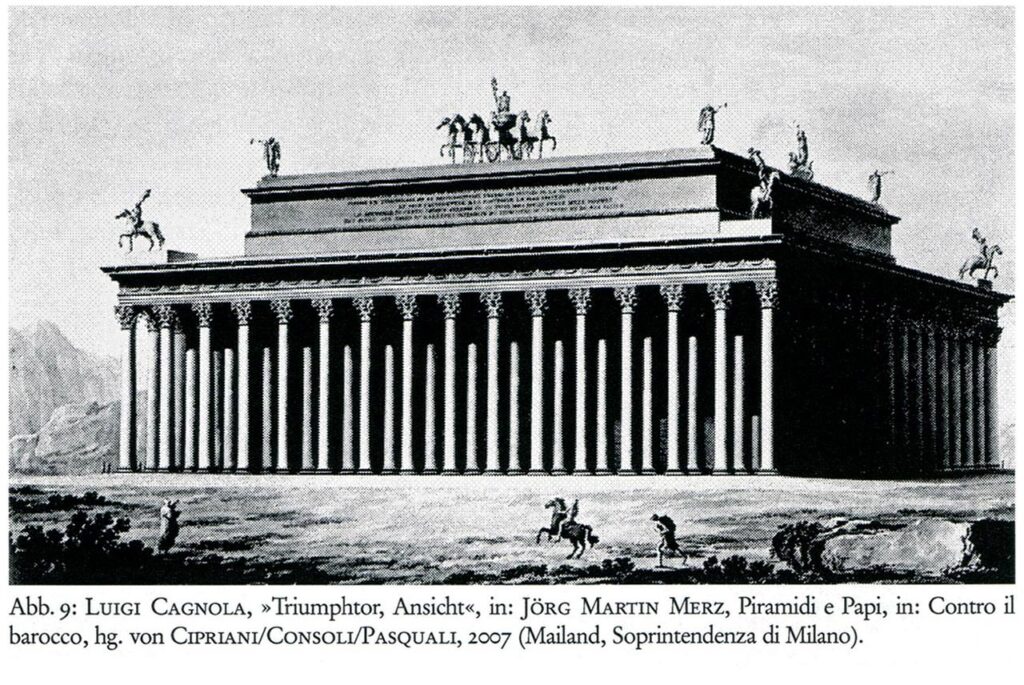
- As for Luigi Cagnola, he imagined a huge building inspired by antiquity.
These pyramid and antique architecture projects are reminiscent of other Napoleonic initiatives, such as the planned pyramid at Montmartre or the one dedicated to the Grande Armée in Paris.
200m-high eagle, giant obelisk...
The architectural competition also gave rise to even more extravagant ideas:
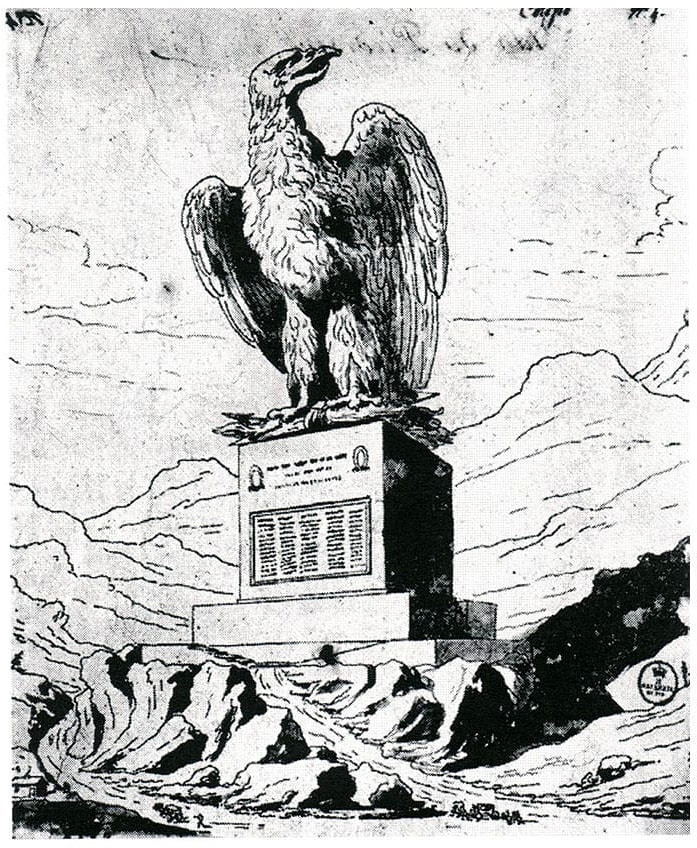
- Giuseppe Manetti, architect at the Florence Academy, proposed a monumental eagle 200 meters high, perched on the mountain.
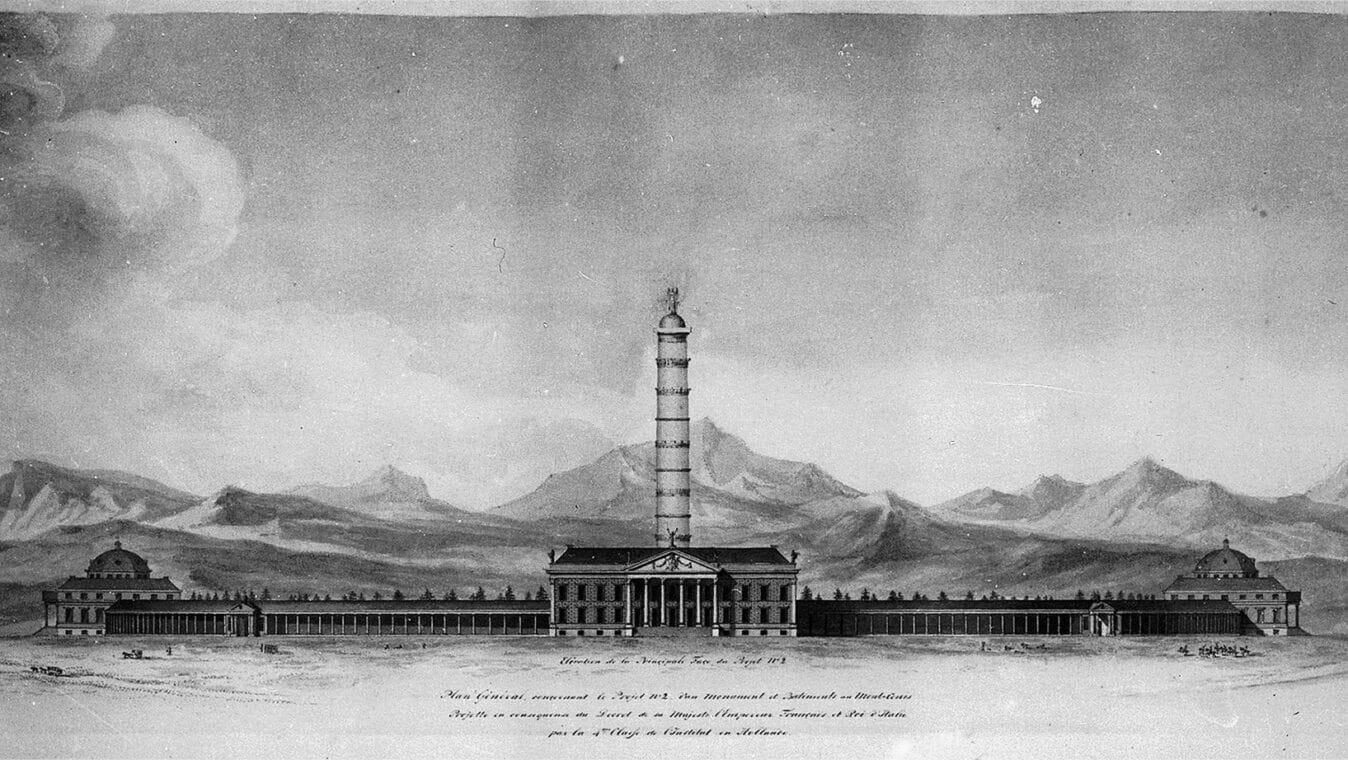
- Guglielmo de Goury imagined a 190-meter obelisk, resting on a base supported by four sphinxes. A "useful" monument, since it was to serve as an astronomical observatory with a guarded fortress at its base.
- Giovanni Antolini, of the Bologna Academy, wanted to sculpt an entire mountain to inscribe a colossal monument: a 600-meter-high die with representations of the Po and Rhône rivers!
- Carmine Lippi, an architect from Turin, went even further, suggesting a navigable canal linking the Adriatic and Atlantic via Mont Cenis! By how many locks would the boats have reached the 2,000-metre altitude of Mont Cenis? The archives don't say...
Military buildings, hospices, galleries...
While some projects are totally unfeasible, others are more pragmatic. Several architects are proposing hospices, schools and military buildings to integrate Mont-Cenis into a long-term development perspective.
Italy's Giuseppe Pistocchi, for example, wanted to build a military academy for 14,500 people in a 6-storey circular building.
As for Gastaud from Maurienne, "garde magasin des vivres de la guerre de Saint-Jean-de-Maurienne", well aware of the difficulties of crossing Mont-Cenis in snowy conditions, he wanted to take advantage of the 25 million to build a 5.5 km-long covered tunnel with 2 lanes of traffic between La Ramasse and the Saint-Nicolas plain. A practical and useful tunnel, part of which would be built a few decades later to house the Fell railroad, even though its construction with gunpowder and crowbars was likely to take a few years.
Battle lost, project buried
And Napoleon didn't have years. In October 1813, his defeat at the Battle of Leipzig, where he lost 60,000 men, forced him to retreat beyond the Rhine. The end was near for the Emperor, and there was no longer any question of a monument at Mont-Cenis. The commission responsible for organizing the architectural competition halted its work.
The Napoleonic monument celebrating the Franco-Italian alliance fell into oblivion and, ironically, a few decades later Mont Cenis was covered with fortifications, bunkers and barbed wire, symbols of the growing tensions between the two countries. After the Second World War, however, Mont Cenis regained its role as a link between France and Italy.
Holidaymakers from both countries passing through the Mont Cenis pass now discover a huge dam lake and an astonishing concrete pyramid. A pyramid that houses the memory of the site, but also recalls the crazy projects of Napoleon's architects.
Flambeau, the vaguemestre dog

Christmas: Jesus was born in Bessans!